
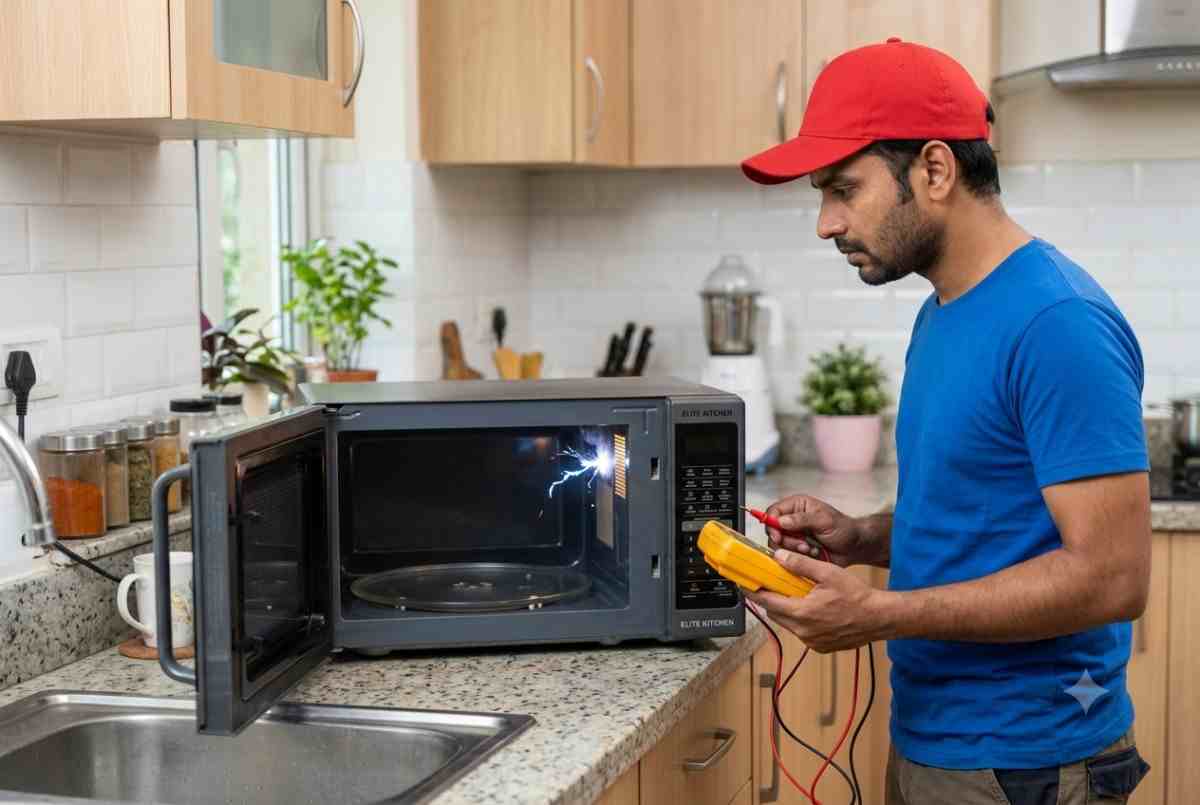
Few kitchen moments are as alarming as opening your eyes to flashes of light inside the microwave while your food heats. If you are dealing with a Faber microwave sparking inside, the cause can be as simple as a stray piece of foil or as serious as a damaged internal part. Either way, sparking is a warning sign. Ignoring it can damage the appliance, burn the interior and, in the worst case, create a fire risk.
Microwaves cook with high-frequency energy that is meant to be absorbed by food. When that energy meets metal, damaged surfaces or burnt residue, it can jump across gaps and produce visible sparks, often with a crackling sound or a burning smell. This guide covers six common reasons for a Faber microwave sparking problem, the warning signs for each, and what to do next.
Note: Faber Appliance Repair is an independent doorstep appliance repair and service provider. It is not an official or authorised Faber service centre.
Table of Contents
- Damaged Waveguide Cover
- Metal Utensils or Aluminium Foil
- Food Particles and Grease Build-up
- Damaged Interior Paint or Cavity Coating
- Faulty Microwave Components
- Incorrect or Damaged Microwave Accessories
- What To Do If Your Microwave Sparks
- Frequently Asked Questions
1. Damaged Waveguide Cover
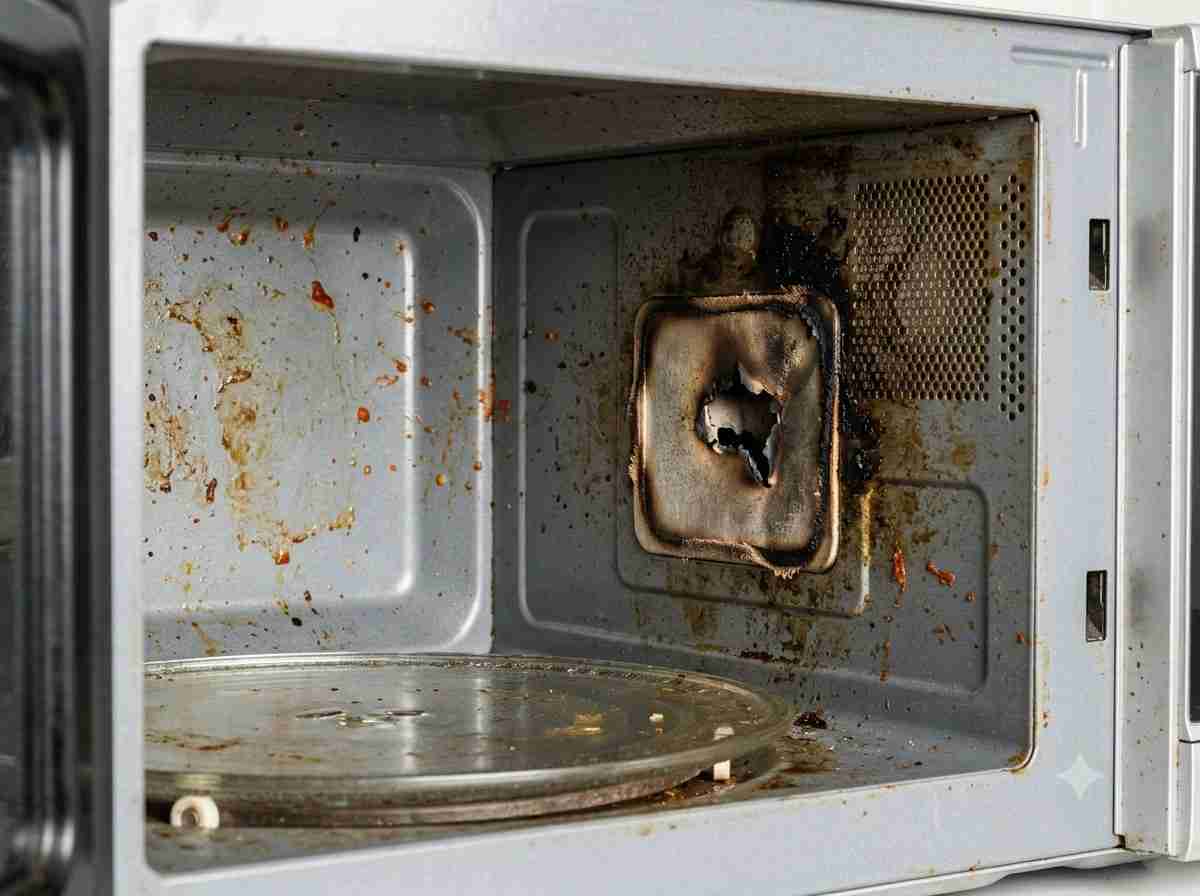
The waveguide cover is a small panel, usually made of mica, on the inside wall or ceiling of the microwave. It protects the opening through which microwave energy enters the cooking chamber. Splashes of oil and food can soak into it over time, and it can crack, warp or burn. A damaged microwave waveguide cover is one of the most common reasons for sparks.
A burnt cover is a frequent cause of a Faber microwave sparking inside, especially when oil splashes build up over time.
Warning signs
- Dark brown or black burn spots on the small panel
- Cracks, holes or a crumbling surface
- Sparks that appear near the same spot every time
- A burning smell during heating
What you should do
Stop using the microwave and unplug it. Do not heat food while the cover is burnt or damaged. Avoid scraping or prying at the panel, because that can make the damage worse.
When inspection is required
If the cover looks burnt, cracked or loose, have it checked and replaced by a technician. A professional microwave repair service can also check whether the damage has spread to the surrounding cavity.
2. Metal Utensils or Aluminium Foil Inside the Microwave
Metal reflects microwave energy and can build up an electrical charge. Forks, spoons, steel containers, foil wraps, twist ties and plates with metallic trim can all cause sparking. Even a small crumpled piece of foil can create dramatic arcs.
Warning signs
- Sudden flashes soon after you press start
- Loud popping or crackling
- Sparks that stop once the item is removed
What you should do
Stop the microwave, wait for it to finish any cooling time, and then remove the item. Use only containers labelled microwave-safe, such as suitable glass or ceramic. Check the dish for metallic paint or gold edges.
When inspection is required
If metal caused the sparking, check the interior afterwards. Scorch marks, pitting or a continued burning smell mean the cavity or other parts may be damaged and should be inspected.
3. Food Particles and Grease Build-up
Dried splatters, oil films and burnt food bits can heat up far faster than clean surfaces. Over time they carbonise and start to spark, especially around the ceiling, side walls and waveguide area. Regular cleaning is the simplest way to prevent this. Neglected grease is another reason behind a Faber microwave sparking inside. The same grease problem affects other kitchen equipment, which is why a chimney repair service is often needed when oil residue is ignored for long periods.
Warning signs
- Visible crusty splatters or oily patches inside
- Small sparks or glowing spots in a particular area
- Smoky or burnt odour during heating
What you should do
Unplug the microwave and let it cool fully. Wipe the cavity with a soft, damp cloth and a mild dish-soap solution, then dry it. Be gentle around the waveguide cover and avoid soaking it. Cover food with a microwave-safe lid to reduce splatter.
When inspection is required
If sparks continue after cleaning, or you see burn marks that do not wipe away, stop using the appliance and book an inspection.
4. Damaged Interior Paint or Cavity Coating
The inside of a microwave is coated with paint or enamel that protects the metal underneath. Scratches, peeling, bubbling or rust expose bare metal, and that is a common source of arcing. Scrubbing with steel wool, abrasive pads or harsh chemicals can cause this damage. Repeated overheating of greasy food can too.
Warning signs
- Flaking, bubbling or peeling paint
- Bare metal patches or rust spots
- Dark microwave interior burning marks that keep returning
What you should do
Do not use the microwave if the coating is visibly damaged. Avoid abrasive cleaning tools, and do not try to repaint the interior with household paint, as it may not be heat-safe or food-safe.
When inspection is required
A damaged cavity coating needs a technician's assessment. Depending on the extent of the damage, a repair may or may not be practical, and only an inspection can tell you.
5. Faulty Microwave Components
Sometimes sparking is not about what is inside the cooking chamber at all. Internal electrical parts such as the magnetron, high-voltage capacitor, diode or transformer can fail or deteriorate. These components work with dangerously high voltage and can store charge even when the microwave is unplugged.
Warning signs
- Sparks, buzzing or humming with an empty, clean cavity
- The microwave runs but does not heat properly
- A strong burning or electrical smell
- Tripping of the household circuit breaker
What you should do
Switch the microwave off, disconnect it from the power supply if it is safe to do so, and stop using it. Never open the cabinet or try to test or repair internal parts yourself. The risk of severe electric shock is real.
When inspection is required
Always. Internal components require inspection by a qualified technician with the right tools and training. If your kitchen has a built-in unit, the same caution applies, and a specialist built-in oven repair service may be relevant for combination models.
6. Incorrect or Damaged Microwave Accessories
Turntable rings, trays, racks and covers that are not designed for your model can interfere with the microwave's energy. Metal racks used in the wrong mode, a cracked glass tray or a misaligned turntable coupler can all contribute to sparks. Non-microwave-safe plastic covers can also melt and leave residue that later burns.
Warning signs
- Sparks near the turntable ring or tray edges
- A wobbling, cracked or warped tray
- Melted plastic or burnt marks on accessories
What you should do
After unplugging and cooling the unit, remove the accessory and check it for damage. Use only the tray and rack supplied for your model, or accessories suitable for it, and follow the instructions in your user manual.
When inspection is required
If sparking continues without the accessory, or you find marks on the cavity floor or walls, have the microwave inspected.
What Should You Do If Your Faber Microwave Is Sparking Inside?
- Stop the microwave immediately by pressing stop or opening the door only if there is no smoke or flame.
- Switch it off and disconnect power safely if there is no immediate danger.
- Wait for the appliance and food to cool before touching anything inside.
- Remove any metal object or damaged accessory.
- Look for burn marks, cracks or damaged panels without taking anything apart.
- Do not run the microwave again to see whether the sparks return.
If there is smoke or fire: keep the door closed so flames are starved of air, disconnect the power only if it is safe to do so, and move away. Call your local emergency services if the situation is not under control.
Is It Safe to Use a Microwave That Produces Sparks?
No. If your Faber microwave is sparking inside, do not keep using it, even if the sparks look small. They can indicate damage that gets worse with every use. Continued arcing can burn the cavity, destroy the waveguide cover, overheat components and create a fire hazard. Keep the microwave unplugged until the cause is found and corrected.
Can You Fix a Microwave Sparking Problem at Home?
If a Faber microwave sparking inside is caused by foil or metal, removing it is a safe first step. Other simple actions include switching to microwave-safe dishes and gently cleaning a cool, unplugged cavity. These are cleaning and prevention steps, not repairs.
Anything that involves the waveguide cover, the cavity coating or the electrical parts is different. Do not open the outer cabinet, and do not touch the magnetron, capacitor or wiring. For these, microwave oven repair at home by a trained technician is the safe route.
When Should You Book a Microwave Repair Service?
Arrange an inspection if the Faber microwave sparking inside continues after you take the basic safety steps, or if you notice any of the following:
- Sparking continues after removing metal and cleaning the cavity
- The waveguide cover is burnt, cracked or missing
- The interior paint is peeling or the metal is exposed
- Sparks occur with an empty microwave
- There is a burning smell, buzzing sound or tripping power supply
- The microwave has stopped heating
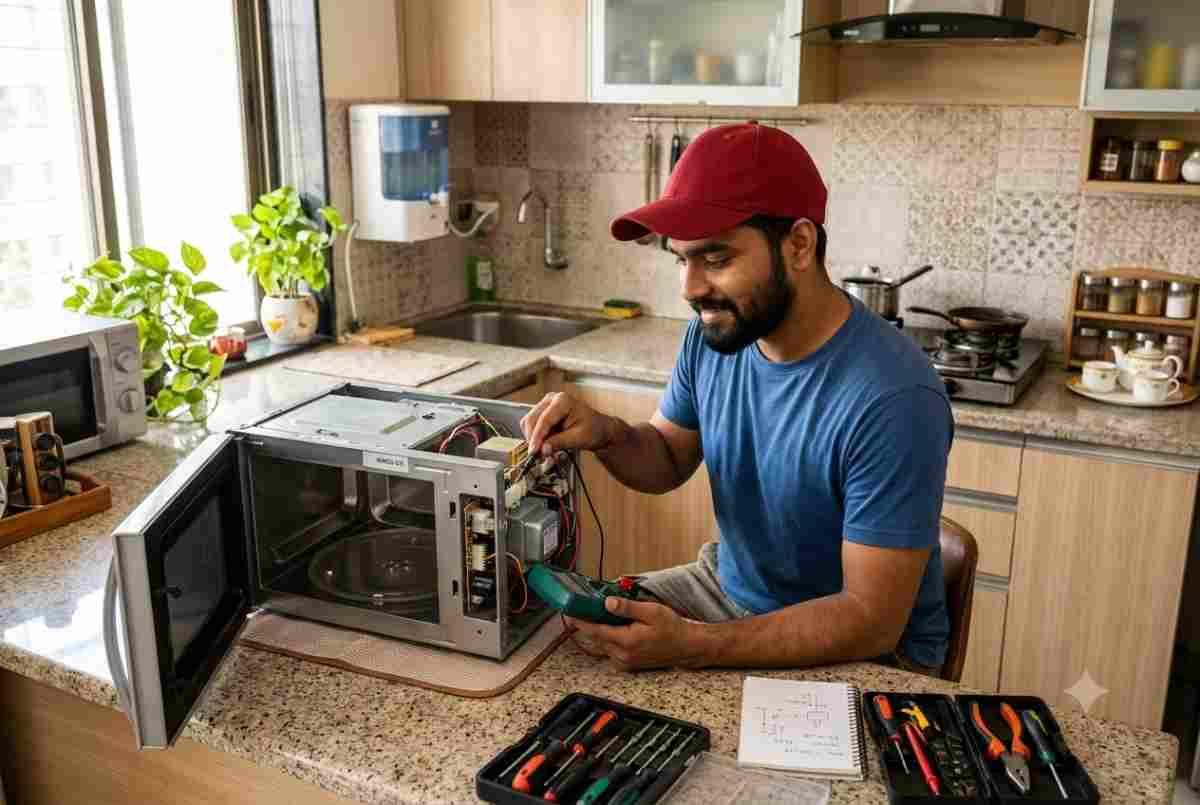
Independent providers such as Faber Appliance Repair offer doorstep inspection for kitchen appliances, subject to service availability in your location. You can also read the frequently asked questions page to learn how appointments typically work.
Frequently Asked Questions
1. Why is my Faber microwave sparking inside when there is no metal?
Common reasons are a damaged waveguide cover, food or grease build-up, a chipped interior coating, or an internal component fault. Stop using the microwave and have it inspected.
2. Can food residue really cause sparks?
Yes. Dried, oily residue can carbonise under repeated heating and start to arc. Regular cleaning of a cool, unplugged microwave helps reduce this.
3. Is a burnt waveguide cover dangerous?
It can be. A burnt or cracked cover can allow food and grease to reach the opening behind it, increasing the chance of sparking and further damage. It should be checked and replaced by a technician.
4. Can I put a steel bowl or foil in the microwave if I use low power?
No. Metal can still cause arcing at any power level. Use microwave-safe glass, ceramic or suitable plastic containers.
5. Should I keep using my microwave if the Faber microwave sparking inside stops on its own?
It is best not to. The sparking may have left damage that will return. Check for burn marks and get the unit inspected before using it again.
6. Does a sparking microwave always need replacement?
Not always. The outcome depends on the cause and the extent of the damage. A qualified technician can assess whether a repair is practical.
Final Conclusion: Faber Microwave Sparking Inside Needs Prompt Attention
A microwave that sparks is telling you something is wrong. The six causes above, from a damaged waveguide cover to faulty internal components, range from simple to serious. The safe approach is the same: stop using it, disconnect power when safe, avoid opening the cabinet, and do not test it repeatedly. Prevention is simple too: keep the cavity clean, use only microwave-safe containers, and check accessories regularly.
If the sparking returns or you are unsure about the cause, get it checked. You can also visit our contact page to reach the team.
Need Help With a Faber Microwave Sparking Problem?
If your microwave is producing sparks, stop using it and arrange a professional inspection.
Faber Appliance Repair provides doorstep appliance repair assistance, subject to service availability in your location.
Call Toll-Free: 1800 210 2966
WhatsApp: 8104268556
Website: https://faberappliancerepair.in/